From September 8 to 11, the annual “Mensch & Computer” (MuC) conference took place in Hamburg under the theme “New Digital Realities”. Centigrade supported the event as a gold sponsor. In four sessions, company employees shared their know-how with MuC visitors. In addition, Centigrade presented “LeanScope Educational”, a software solution that supports UX professionals in user-centered requirements management and sparked strong interest among the professional audience.
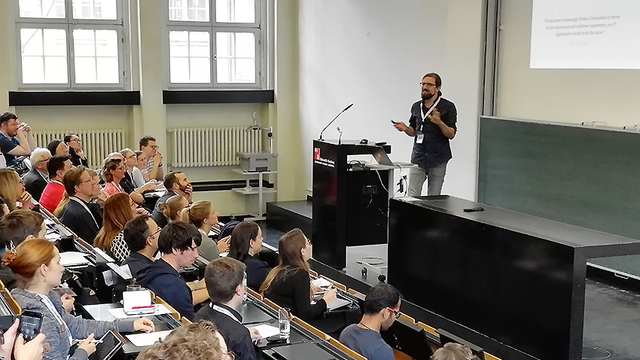
Design systems, user stories, “Definition of Done Done Done”, Continuous UX, and the development of a VR-supported game – Centigrade at Mensch & Computer 2019
Support for aspiring and established UX professionals
Visitors to Mensch & Computer who were looking for suitable software to support their work found what they needed at the LeanScope booth. There they were able to get to know the UX tool “LeanScope” in two versions. In the Lite version — LeanScope Lite — individual persona posters can be created and shared with the team. With LeanScope Educational, established UX professionals can discover a tool that simplifies the entire process of user-centered requirements management. What particularly impressed visitors was that LeanScope Educational not only supports UX owners working alone. Rather, interdisciplinary teams are supported in analyzing user needs, creating customer journey maps, and defining user stories, so that a holistic process in the sense of Continuous UX is covered. LeanScope was also used in the sessions given by Centigrade employees on site.
Lots of system, but little design? How design systems can become more adaptive so they do not stand in the way of good UX

Digital products are becoming more complex every year. In addition, they often no longer stand alone, while companies increasingly think in terms of platforms. In his talk, Thomas Immich therefore used a concrete guiding example to demonstrate the evolution of an adaptive design system and its advantages.
Definition of Done Done Done? Why acceptance criteria should also be based on real user behavior

Using the research project Opti4Apps as an example, Britta Karn showed how an innovative approach to usage data analysis was developed. Through measurable user acceptance criteria, product owners are enabled to make decisions regarding backlog prioritization. The usage data analysis complements the “Continuous UX” toolkit by integrating user feedback regularly and automatically.
Little heroes, big impact. Developing a VR-supported game to support therapy for pediatric patients

What must a VR game offer to motivate children with motor impairments, and how can self-efficacy and a sense of competence be conveyed? In another session, Britta Karn addressed these questions using the “MightyU” project as an example. The session highlighted the relevance of engaging with usage scenarios and personas in an agile design process. It also presented how UX research methods were used in the project to identify motivational and frustration-related aspects of the target group and how these ultimately influenced design decisions.
Problems first! – Gaining development time for innovation through problem-oriented user stories

At Mensch & Computer 2019, Miriam Julius presented a tutorial on how user stories only truly become user-centered through problem-oriented formulations. Participants learned the criteria of a problem-oriented user story, practiced writing user stories, and developed innovations from them. Methods and tools were introduced and applied. Finally, participants were given an outlook on user story-based usage data tracking.